Background: Understanding Your Electrical System
When troubleshooting electrical problems in a house, you can avoid watts of frustration by learning or reviewing things about your electrical system. When you have learned enough, you'll be ready to go to the page for Troubleshooting these problems in your own home. Disclaimer.
Page MenuSee also: How Things Go Wrong
Your Home Electrical System: Electricity flows to your lights and appliances from the power company through your panel, its breakers, out on your circuits and back. Here is a schematic picture of all the major parts of your home electrical system.
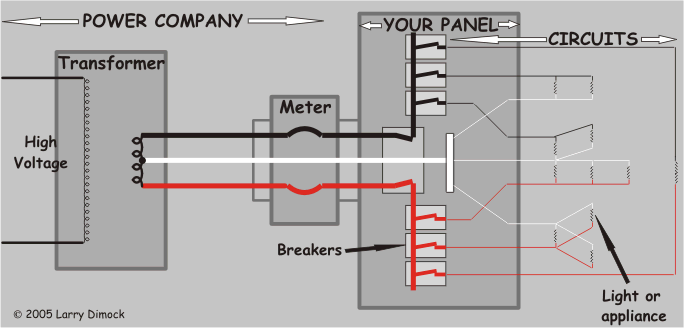
There are many connections along these paths that can be disrupted or fail, and there are many ways that electricity could go places you don't want it to. See my
Is electricity mysterious? article and my
Electrical as a second language article.
The Power Company: Your electrical utility company and its distribution system bring power over wires and through switches and transformers from the generating plant all the way to a point of connection at your home.
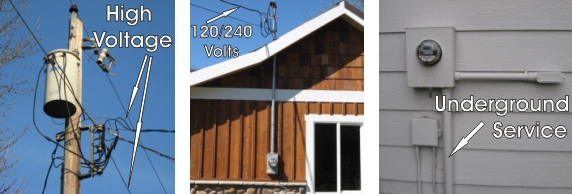
The utility's system itself can have trouble that can affect things in your home. Its built-in safety features can stop power in time, but other connections, broken lines, storms, imperfections, or mistakes can sometimes allow unusual voltages into your system, possibly damaging parts of it. The sensitivity of home electronic equipment to this has made us more aware of this possibility, so that our use of surge protectors has become common. But some surges are difficult to protect against and can be similar to lightning strikes in their effects.
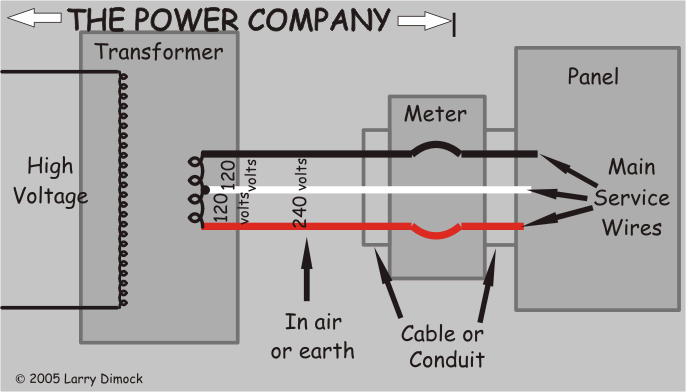
This diagram gives a closer look at the source of 120 and 240 volts in the company's transformer.
Your Main Panel: Your central breaker panel (or fusebox) directs electricity through your home as a number of separate circuits, each flowing "out" from its own circuit breaker (or fuse) on one wire and returning from whatever is using the electricity to another connection in the panel by means of another wire. The breaker or fuse will interrupt the current (the flow) if it ever starts to approach a dangerous level. This diagram compares a main panel as I have diagrammed it so far, with how a typical panel is arranged:
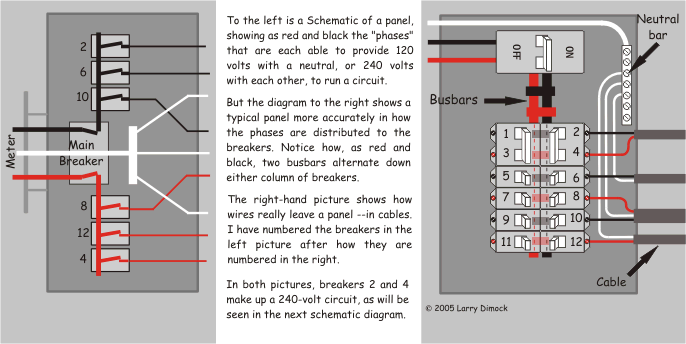
There may be in the panel a distinct "main" breaker that can shut off power to most or all the circuits. If not, there could be one near the power company's meter. These devices automatically turn power off, but connections at any one of these points -- at the meter, at the main breaker, inside the main breaker -- can fail or become unreliable, disrupting some or all the power in your home.
Circuits: A circuit is a path over which electric current can flow from and to an electric source. This concept could use some clarification. If it were always as simple as current from the source following only one possible path out to one light and back by one return path, then the operation or malfunction of a circuit would be easy to grasp. But it is not so simple. This diagram lets you trace the path of one circuit as it goes through your system:
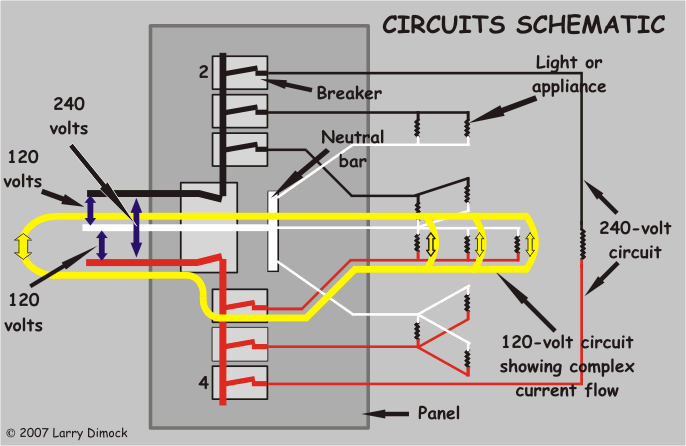
Code and convention define a circuit in a home as having its source at one of the home's circuit breakers or fuses. Taking this as the starting place of the electrical source, then, we will find that most circuits in a home are complex, involving sub-branches like those of a tree.
By Code, a dedicated circuit is used for each of most large appliances like the electric range, electric water heater, air conditioner, or electric dryer; these as well as electric heaters will have two (joined) breakers in order to use 240 volts rather than the 120 volts used by most other items. A dedicated circuit of 120 volts is usually provided for each dishwasher, disposal, gas or oil furnace, and clothes washer. Most other 120-volt circuits tend to serve a number (from 2 to 20) of lights and plug-in outlets. There are usually two circuits for the outlets in the kitchen/dining area, and these use a heavier wire capable of 20 amps of flow.
Circuits serving more than one outlet or light pass power on to successive locations by means of connections in the device itself or in the box the device is mounted in. So on any one circuit there are many places where electricity can fail to get through -- from the circuit breaker and its connections, through a number of connections at devices and boxes, through switches, and at the contacts of a receptacle where you plug something in. Troubleshooting electrical problems in your house will depend on a basic grasp of these matters. (Want help on How to label your panel's circuits?)
Sometimes the behavior of electricity in a home is explained by a comparison with plumbing. Water and what it does are less abstract. But the analogy is very limited. It is true that water pressure (voltage) through a certain size of pipe or showerhead (resistance) can result in a certain rate of flow (current), and that a certain number of gallons (kilowatt-hours) will thereby be delivered. But what would a circuit mean -- in plumbing terms? Water pressure ends at the sink or out on the lawn beyond the sprinkler. The return of water back to a reservoir is very round-about. Electrical wiring is a tighter system, a more closed system.
Wires: hot, neutral, ground: To understand the function that different wires in a circuit play, consider first our use of terms. Because a house is provided with alternating current, the terms "positive" and "negative" do not apply as they do to direct current in batteries and cars. Instead, the power company is providing electricity that will flow back and forth 60 times per second. The electricity flows through the transformer, on the one hand, and the operating household items, on the other hand, by way of the continuous wire paths between them.
Two of the transformer's terminals are isolated from the earth and the third is connected to the earth. We call these isolated wires "hot" or "live" because anything even slightly connected to the earth (like us!), when touching a hot wire, provides, along with the earth, an accidental path for electricity to flow between that wire and the transformer's "grounded" terminal. (See this very good Portrayal of shocks by an engineer-type).
A circuit's hot wire is, we might say, one half of the path the circuit takes between the electrical source and the operating items ("loads"). The other half, in the case of a 120-volt circuit, is the "neutral" wire. For a 240-volt circuit, the other half is a hot wire from the other phase -- the other hot coming from the transformer. When they are turned on (operating, running), the loads are part of the path of the current and are where the electricity is doing its intended work.
Hot wires are distributed into your home from a number of circuit breakers or fuses in your panel. Hot wires are typically black, occasionally red or even white, and never green or bare. The earth-related neutral wires in your home are also distributed from your panel, but from one or two "neutral bars". Neutral wires are always supposed to be white. Contact with them should not normally shock you because they are connected to the earth much better (we assume) than you can be. But contact with a hot, even one that is white-colored, will tend to shock you. Even when they are switched off, we call these wires hot to remind ourselves that they will be, and to distinguish them from neutrals and grounds.
Besides black, red, and white wires, the cables in homes wired since the 1960's also contain a bare or green "ground(ing)" wire. Like the neutral, it is ultimately connected to the tranformer's grounded terminal, but this wire is not connected so as to be part of the normal path of flow around the circuit. Instead, it is there to connect to the metal parts of lights and appliances, so that a path is provided "to ground" if a hot wire should contact such parts; otherwise you or I could be the best available path. (In this diagram see if you can picture the different paths taken by normal current and a short-to-ground:)
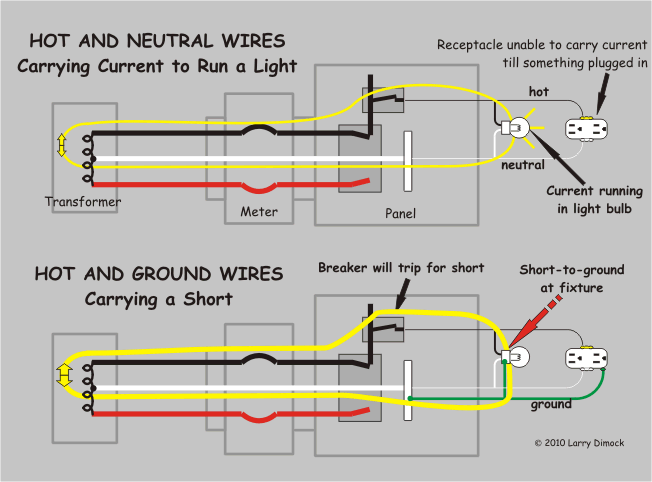
In other words, when a ground wire does carry current, it is taking care of an otherwise dangerous situation; in fact, it usually carries so much flow suddenly, that it causes the breaker of the circuit to trip, thereby also alerting us that a problem needs attention.
Switching: By code, convention, and good reasons, only hot wires are supposed to be switched, never neutrals or grounds. This diagram shows how a household switch works:
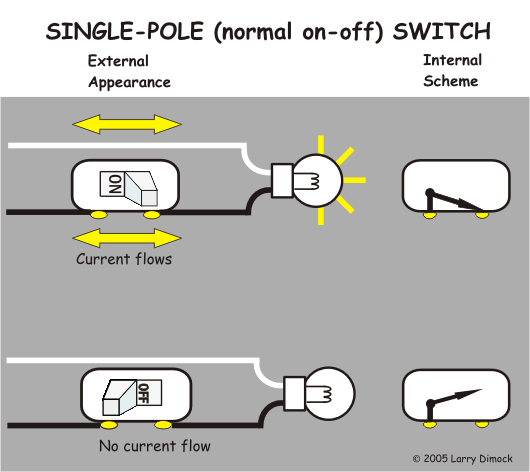
A switch is a device that continues the hotness of a hot wire on through to, say, a light or else discontinues that hotness. So the black or red wire between a switch and its light is not always actually hot; when it is not hot, its color is still valid, to remind us that it will sometimes be hot. There is a form of switching in which two or more switches can each control a light. These are commonly called three-way switches. They normally work by one switch continuing hotness to another on one or the other of two "traveler" wires that run between the switches; the final switch connects either the hot traveler or the unhot traveler on to the light, thus energizing the light or not. I give more
Discussion and diagrams of 3-way switches.
Other specialized switches include dimmers, motion sensors, photocells, timed switches, thermostats, and "smart home" (X-10) switches. You can get my tips about these at Automatic controls.
Tour of a Circuit: This is where you will see a house wiring diagram, though not of a whole house. There are diagrams (here's a Preview) of a switched outlet, three-way switches, a series of outlets, and all the switches and lights related to them. So that you can experience the ins and outs of a circuit in practice, take the Tour. (Those who like puzzles will even find three troubleshooting challenges at the end of the tour). Then to compare this same circuit as it connects in electrical boxes with how its cables would be run in a particular set of rooms in a home, go to Circuit cabling. I recommend you view these files; you may recognize things in them that are like what you find in your own home.
For the more advanced. Working with a more complex issue, you might want to beef up your education with this Tutorial about the connections in electrical boxes. And I have this page full of Connections Diagrams, which is to show most of the possible ways wires connect in outlet, light, and switch boxes.
"It sure beats the [heck] out of calling up or walking into an electrician's place of business to ask for FREE help and advice--which I'm uncomfortable with! That's not much different from walking into a restaurant with your own ham and eggs!! (LOL) Just the same, I don't feel like paying "full freight" for a service call, either--not because I'm a cheapskate, but because I always hate getting "pinched" for something that I could probably do myself with just a little outside knowledge and help!" -Rich
"I thought surely there would be a mountain of information online about basic house wiring? The problem is that there IS a mountain of information, but it is not all in one place nor easily accessible to a layman. At least, that is how it felt until I found your site. Finally here was a place which had all the information I was looking, and was presented in a nicely logical and easy to understand fashion." -Tom
"The absolute best home electrical site I could find on the web. The diagram with the step by step reading helped me finally grasp the basics of home wiring." -Todd, WI