
Troubleshooting Electrician for Seattle's Eastside:
Bellevue, Kirkland, Issaquah, Redmond
Laurence Dimock, The Circuit Detective, was Seattle's Eastside's troubleshooting electrician for mysterious malfunctions in homes.
Unfortunately for you, I have retired. Listed as one of the best by KOMO News, you are still in good hands -- if you are willing to learn more about your electrical system so as to solve that problem yourself. For help with that, please go to my thorough Electrical Troubleshooting material.
I am also maintaining this Eastside web page for the sake of all my former local customers, whom I helped in person over the years. I am sorry that I can't be available to you any more, but in general I do recommend the licensed electrical contractor named Alive Electric.
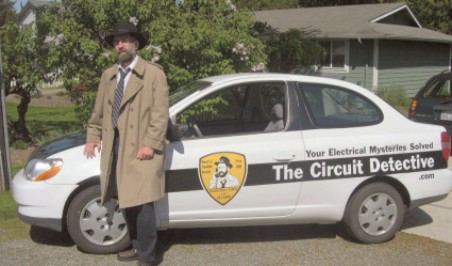
Examples of My Work Over the Years
One kind of "blink" is a dimming and/or brightening of lights. This happened at Dave's house at unpredictable times. But I wasn't far away, so I came one evening when it was happening. It was a voltage problem, so we had Puget Sound Energy come check things. Nothing. But since the problem recurred, we had them put a recording-volt-meter on their lines for three days. Nothing! Since it acted up after the three days, I went to bat for Dave. I called up Puget and assured them the trouble wasn't in the house. I told them to try actually redoing two of the line connections. After they did that, there was no more problem.
Some of Alan's living room plugs and garage lights weren't working. A simple test of that circuit showed me that somewhere along the line one of the neutral (return) wires was broken or loose -- but where? After undoing two or three devices to check their connections, I followed a suspicion to the dining room light, which itself was working! Up in its electrical box was the loose junction, probably put together poorly by someone who had taken the light down during recent remodeling.
Here's a good one. A breaker in Pat's garage tripped and wouldn't reset. Fortunately all the wiring was still accessible (no sheetrock). I traced the short to a place along one wire. I opened the wire ("cable" to be more accurate) and found that the factory had made a splice inside the cable but hadn't taped or insulated it. This is very rare. The splice had finally come close enough to the bare ground wire next to it to short over. I repaired it with a proper splice.
Bellevue. Small Job in Eastgate. What might be interesting in this story is not the details of a bad connection knocking power out to several rooms, but how I got the job. The homeowner told me he had found me by referral from someone at work. He described the outage and the fact that he had had a new electrical panel installed within the last year. After I had taken care of his problem, he revealed that before finding me, he had spent most of that day calling electrical contractors with attractive ads. He said none had called him back. I said, "Did you tell them that you had a new panel, like you told me?" He said, "Yes. why?" I said, "Maybe that's why they didn't call back." It is an unfortunate thing for the general public when so many electrical contractors gear themselves so heavily to upgrades that are much bigger than your basic need.Bellevue. Faulting Line in Bridle Trails. Don was right to suspect that the ground-fault interrupter (GFI or GFCI) was tripping off for something outdoors. After all, his fountain was on that line, and we know that water and electricity don't mix without potential problems. An outlet or two in the living room were on the line affected by the GFI, and the GFI itself of course, which was in the garage. But as I got acquainted with the circuit, I discovered that an old refrigerator in the garage was actually responsible. With it unplugged, the fault was gone. If it was worth it to Don, he could have that fridge repaired.
Carnation. Tale From Tolt Hill / Deja Vu. Ron called me to his place on Tolt Hill. The address was a little hard to find. It shouldn't have been, because after a while at the house, I realized I had been here before. In fact, the handwriting in the electrical panel helped me realize that I had wired this house back in the early 1990s! Second-owner Ron's problem was a light on the house and a shed, both controlled by the same switch, were dead. I could barely recognize the switching system as the one I had installed. Apparently, when the shed was built later, an engineer-type had rigged a way to switch the shed on with this light. So I had to get acquainted with his relay system. That helped me learn what my memory wouldn't tell me -- that the light on the house was switched not only from the garage but fom the front door as well, and that there was another light on the house (which was working!) switched with it. When I took those two lights on the house down, I found (at the second one removed, naturally) a loose connection and fixed that. That solved the problem. Ron put two and two together when I told him. Some months back, he said, painters had removed and then rehung these lights. I figure, painters are just apprentice electricians in need of a little more supervision.
Carnation. What I Won't Do to Solve a Mystery! Beth has a house right in Carnation, built in the 1960s. Her main baseboard heater wouldn't work, and she had bought a new one for me to put in its place. I wasn't so sure. True, the other heater controlled by the same thermostat still worked. And I checked connections at the thermostat. But the connections at the heater were good, and its heating element tested as good! So it would do no good to replace the heater. Something was wrong between the thermostat and this heater. Where? The wire between them either ran through the attic or the crawl space. I prefer to visit neither. That is a young man's game. It's one of the reasons I gave up rewiring houses. But for the sake of the mystery, I bite these bullets. I went under, in overalls. It was eight on a nastiness scale of ten. But sure enough, directly below the area of that heater was a splice point where a connection had failed. After fixing that, the only bad news was that Beth would have to return the new heater. Some people would have started to look forward to a fresh-looking heater, but Beth was old school. If it isn't broken...
Trouble Shooting Story in Duvall. John has one of the newer homes up on the hill. From the beginning an outlet in the kitchen and one in the dining room never worked. The electrical contractor did not address the issue. I poked around for a tripped GFI or a loose connection on two nearby circuits. But when I checked to see if any of the three wires of the bad cable had continuity to elsewhere, only the bare ground was good. A wire tracer I have pointed me along the wall from the kitchen outlet. This wall should have had two outlets by code, but only had the one. More often than you would think sheetrockers cover electrical boxes. Usually I can narrow down where to cut in for the box by holding a straight-edge against the wall till I notice a bulge. No bulge this time. Some other tests made me brave, and sure enough I found the box and gave it a receptacle so that the dead ones could come to life.
Fall City. Accidental problem. Laura was out of power to her home office. I quickly noticed the set of generator transfer switches near her main panel and that one was knocked out of position. Turning that back on took care of things. The circuits set up to be capable of running on generator are often the most important ones in the house. A generator setup is definitely a positive feature for a house, but people are not used to looking beyond the main panel to solve their outages. This has also been true of tripped ground-fault interrupters. Get acquainted with the location of all these "GFIs" (and generator switches) so you won't have to have them found by an electrician.
King County. In the Lake Alice area. No one likes the thought of a short circuit happening in the wall, where you can't see it or get to it. This problem was close to that. The man of the house had already looked in some electrical boxes of the circuit. But then he told me that one time the breaker didn't trip till his wife turned on the front lights. By undoing certain wires at these lights, I narrowed the short down to the light by the front door...OR the wire in the wall from the switch inside out to this light. Actually, the wires behind the light came directly out of the siding, but I knew from a missing ground wire that there was a box (or at least a splice) behind the siding. I'm not a carpenter, but I pulled two boards off as carefully as I could. There was a metal box! And there were a few suspicious long sheathing nails near the path the cable was running in the wall. It turned out after exhonerating the nails, that the short was not in the wall but at the light's box. The electrical contractor who had run the cable into that box had tightened the clamp to hold the cable so tightly it began to short these several years later. I was able to repair the wire and get the siding back on pretty well (for an electrician).
King County. Out in Preston. I learned something new about vintage light fixtures when I was called to an old mansion. The lady reported that one particular circuit was tripped and wouldn't go back on. Sure enough, a short of some kind. Now, many people apologize to me for the mess their house is in, thinking that I care. If anything, clutter adds to the challenge, although I do prefer electrical challenges. This lady was apologizing too. She had a lot of stuff around. But as I was getting acquainted with the problem circuit, I saw a closed door that she seemed to be shying me away from. "What's in there", I said. "Oh, you don't want to go in there", she said. I managed to convince her that I needed to and that I didn't care what it looked like. In I went. I truly don't remember it being that bad. What I did notice, however, was that, like the other bedrooms I had looked at, this one had a heavy and ornate old chandelier. On the "arms" of this one, though, she had hung a lot of clothes, using wire-type hangers. Ordinarily that would not be noteworthy, but these fixtures had the two wires for each bulb running along the top of each arm, not inside the arms (solid brass, not hollow). As I looked closely, I did see that one of these fixture wires was worn bare against the metal because of a hanger. But this house is so old, I thought, the metal won't be grounded, so how could a short occur? My answer was on another arm of the chandelier, where another wire (of the opposite polarity, I gathered) was also held bare against the metal. So this was a hot-to-neutral short through the metal of the fixture. I don't remember how I repaired this, but I had a little talk with my customer about where she was going to hang her clothes from now on.
Kirkland. Forbes Creek area. My wife and I remember the little daughter of a high school friend of ours. When paying us a visit and hearing what I do, the mother virtually set me up to go to her daughter's place because she knew there was an electrical issue with something there. This girl is now a surgeon. With her husband's blessing, she had taken on some upgrading of switches at home, but things weren't working quite right. I admire the attempt. I'm not equally up to using a scalpel. Anyway, I found the misconnection at a four-way switch for the stairway and showed her how to avoid similar mixups elsewhere in the house. I think she'll finish that house-surgery with a healthy patient.
Medina. Older House on Rambling Lane. Some lighting circuits in a home are extensive enough that when they go out, it seems like "half the house is out." That is how many people describe that situation to me over the phone. This homeowner had a less common problem, however. His house's power WAS half out! From testing at his panel I determined that half of the 240 volts coming from the utility was missing. Outdoors I saw that a wire in the overhead line from PSE had been worn through by a branch it passed by. Besides a tree's growth, its motion from wind can contribute to this kind of thing. We called PSE to make that repair. (I'm sure they told the owner to get the tree pruned back too.) When much of your electrical system is in malfuntion mode it is not always clear whether to call an electrician or whether to call the utility. Toss a coin?
Mercer Island. Automatic or Manual? Along West Mercer Way, Fred's motion-sensor floodlight was rather important for covering the stairs up to the front porch. Lately it was not working! Naturally he put new bulbs in it, but called me in when that failed to bring the light back to life. Certainly the sensor part itself can go bad, but I found that the wires behind the light were also dead. No breakers or ground-fault interrupters were tripped. When a motion light replaces an existing light, there is usually a switch ahead of it. The motion light does not need the switch and can in fact be thrown off (into staying on all the time though) if you flip the switch in a certain way. So I went looking. Finally I found the switch in a loft storage area. Fred was unaware of this switch. Apparently when some things had been stashed against the switch, they had knocked it to Off. Now Fred could once again go stand on his stairs to greet expected visitors (and not be able to enjoy the stars while waiting -- because of that darn motion light).
Monroe. A Heater Is Like a Mule. It works hard day in and day out, and then one day decides to stop altogether. That's what had happened at David's place, way out on Friar Creek Road. The family room in-wall heater would not turn on anymore. There are a lot of links in this chain, from the circuit breaker, through the thermostat, to the high-heat cutoff, and finally the heater's element. Plus any of the wire connections at all these locations. In this case I found that the cutoff had popped. These are easily reset by pushing a little button hiding behind the grill, which I did. The question is, why did it pop off? They do that when the heater is getting abnormally hot and therefore dangerous. Although it can happen because of a temporary obstruction, like a box set in front of it, more often it signals that the fan of the heater is not moving air past the element fast enough. That in turn could be from accumulated dust on the element, the fan's bearings wearing out, or a wrong grill. In David's case I saw no evidence, once the heater was working again, of any of these, so I did not propose to replace the heater. It is possible during a cold snap for a heater to run almost constantly and to end up finally getting too hot that way. I showed David the reset button and called it good. I took it as good news that he did not need to call me back later that week (as I told him to if the problem recurred).
Newcastle. Timer Switch. Ken had used me before, and since he knew a good electrician, he called me back. (I hope people don't stop trying a few ideas themselves, just because a previous problem was beyond them.) This was a matter of two outdoor lights not working. They were supposed to operate automatically from a timer switch, but its digital readout was now blank. Bad timer? I thought so at first, but when I temporarily replaced it with a standard switch, the lights still did not work. It turned out that the bulbs were both burned out (which can be expected at some point from lights left on all night). Once they had new bulbs, the timer worked again. You see, some electronic timers won't operate unless there is at least one good bulb in the lights! But who knows that kind of thing?
North Bend. Along Highway 202. When you are new to a house and when you are selling are common times for circuit problems to need solving. This North Bend man called me because he was alerted to the fact that some of his new home's outlets did not have a good ground reaching them. Usually people aren't aware of this condition because it does not affect normal operation. But he knew he wanted definitely good grounding so that his surge protectors would be capable of protecting his electronic appliances. This home was not an old one that was built before grounds were being wired into buildings. Most of his outlets did show a good ground, and the outlets he was concerned about even showed the bare ground wires in their boxes, hooked up to the receptacles. Where was the continuity of the ground broken? After looking into the boxes of nearby outlets, I got into my overalls. Why? This was a mobilehome, which also has circuit connections underneath it at a "crossover" junction box. By process of elimination, that was almost the only possibility left. Once I found and opened that box, I saw that whoever had joined the wires there when the mobilehome was set in place here, had neglected to join the ground wires. Did he have one too few wirenuts? Anyway, I did what he hadn't. It was safe to run the electronics now.
Redmond. Education Hill Story. Pam told me her washing machine might have a short. Its circuit's breaker would trip off after awhile when she did the wash. When I got there, power to the machine was on. Yes, it could be that a short in the machine would only show up at a certain point in the cycle. On the other hand I wanted to look at that breaker. It sounded to me like the breaker was just getting hot from a poor connection in or around it. Heat is able to trip a breaker even when current is normal. The breaker felt OK when I turned it off and back on, but I opened the panel and pulled it out. Sure enough, it had been making heat with the live busbar it gets power from. It had been arcing from poor contact with that bar. So I replaced it. Not in the same place in the panel though. The arcing had done a little damage to the busbar there; any new breaker at the same spot would develop the same problem over again in a matter of months.
Snoqualmie. Simple fix? A simple solution doesn't always mean easy to come by, even for an electrician. Out in Ernie's Glen this family I had done work for in the past was missing power to a number of outlets. This house was newer, not the one I had worked on before. The dead items were outdoor outlets -- which would have been required to be protected by a ground-fault interrupter (GFI). So I wanted to know if and where such a device existed. All it takes is for a GFI to trip off and it will kill power to all the protected, normal looking outlets downstream from it. We looked all over. Finally, with a little help from a wire tracer I have, I found the GFI inside the coat closet by the back door. Resetting it restored power. Simple, once the treasure hunt is over! Why was a GFI put there? Sometimes an electrician might imagine that people don't want to go outdoors in the cold to reset a tripped GFI. Or he might not want to try cramming the GFI into the smallish boxes that are used for outdoor outlets. Who knows?
True Detective Story from Woodinville. At a house above Woodinville High School, Jonathan had been too confident in his electrical abilities. He was replacing all his switches and receptacles. After he was all done and put power back on, one switch turned everything in the next room off. Another couldn't turn its light off. And some other rooms were just dead. He wasn't distressed; calling me in was just part of the process. I did find and correct 7 places he had hooked wires up wrong. Once I had seen how he dealt with the hookups at one or two, I found the rest without too much fuss. He was consistent. And he wasn't embarrassed. Some people get very embarrassed. I don't care if a customer is embarrassed or not. I was comfortable with the $101 it took. I think Jonathan was too.
Issaquah. Tough problem toward Cougar Mountain. Downstairs in this mother-in-law apartment, the dining room outlets and light were not working and she was to entertain guests there that evening. This electrician, Issaquah, had to pull out all his tricks for this one, and it took me a few hours (not usual at all). I knew there was a bad connection along the circuit, but when I had checked at all the obvious visible outlet boxes, I began to wonder if this was one of those rare splices in the wall (no box, no cover). My wire tracer showed me where the bad wire went in the walls till it was bad. The suspect place was in a wall behind kitchen cabinets or (other side of same wall) behind a bathroom cabinet. I pulled drawers out. In the bathroom I opened an exploratory hole and felt a wire and a box in the wall. Since it seemed to be facing the other way (toward kitchen), I measured and opened another hole behind the drawers of a kitchen cabinet. There was a receptacle that had been left buried behind these kitchen cabinets when the kitchen was remodeled four years ago. And this outlet was having a problem with one of its connections that was supposed to pass the circuit along. I made the repair and turned that box into a junction box with a blank cover. I think the lady was happy. The whole time she and I had been in each other's way in the kitchen, because for her part she was very busy cooking up some special things for that dinner.
Sammamish. A Plateau Puget Problem. Dave had told me that lights would dim down at times in various rooms. I wasn't sure he had anything wrong, since this can be normal to a degree when heavy appliances turn on. But I came to check it out. And I did start to observe the voltage dragging down at times. At his main panel I found that some other circuits were being subjected to a little higher than normal voltage. This is typical of a poor main neutral wire. When I saw the meter equipment outdoors, it was deja vu. Dave had the same meter-can brand that I do at home. I had been through a similar experience of lights dimming rather pronouncedly, until I saw behind my own meter that Puget Sound Energy's main neutral was too small for the clamp-connector in the meter equipment. Just enough that things would run OK but give lights an annoying deep blink. This situation is not healthy for electronics in a home. I went to bat for Dave by calling Puget myself (do you think they'll listen to a non-electrician?). They promised to come correct the matter.