Is a circuit breaker tripping for a short, or has it just gone bad? What does an outlet tester mean by an open neutral, hot, or ground? Could receptacles not working be from an unknown tripped GFI?
Residential electrical problems can easily put a do-it-yourselfer in need of troubleshooting information and tips. Such electrical advice is what this page is about.
If you know how to test a circuit, you may want to pursue your problem directly using the Diagnostic Tree. If you could use more information about your U.S. or Canadian system, how it works, how to test it, or how to best approach it, then the text below (and the Background page) will be helpful. Disclaimer.
|
THIS PAGE: Safety T-Shooting In a Nutshell A Strategy Overview: Symptoms Narrowing the Cause's Category Pinpointing the Cause's Location Testing Repairing |
OTHER PAGES: HOME: The Circuit Detective FAQs A Diagnostic Tree Background Info on your System Brief T-Shooting Tips Glossary of Terms Contact Detective Larry |
Though some residential electrical wiring troubleshooting can be done without the potential of shock to the do-it-yourselfer, some cannot. In either case, try to understand your electrical system enough to avoid shocks. Even when you think you have turned off the right things, treat them, if possible, as if they might still be live. In addition, keep any testers or tools with metal parts from making unintended contact with potentially live OR with grounded parts, because burns and explosions are possible. Also, in reconnecting or in repairing things in your system, the more you attend to proper procedures, the less you risk future disruptions or fire hazards. Go to these websites on Shock and on Electrical fires. You can learn My opinions on safety. I don't want these tips on residential electrical problems and your electrical troubleshooting testing process to be a bad experience for you.
Here is a quick, concise look at how to find the source of residential electrical problems. For better details, skip to Strategy.
If one thing isn’t working, turn it on or replace it. If more than one thing is not working, reset breakers and GFIs. If they still don’t work, locate the bad connection by improving connections at the interface between live and dead things of that circuit (if you know the circuit) or between the dead things and any nearby live things (if you don’t know the circuit). If they still don’t work, you can replace the breaker and check the neutral connections at the panel. If more than one circuit is affected, be sure that main and submain breakers are not blocking the voltage; then call the power company.
If the breaker or GFI retripped upon your resetting, unplug or switch off everything you can (on that circuit, if you know it, otherwise everywhere) and try resetting again. If it holds, see which thing you undid sets it off; but if it didn't hold, break the circuit’s hot apart midway along the circuit and try resetting. Continue reconnecting the circuit and breaking the hot apart at other places (one at a time) to narrow down where the fault is occurring. If it was the GFI retripping, go back after these procedures and break the neutral apart in a similar way in case this will narrow the location down.
If, instead of not working, the problem is that blinking, flickering, dimming, or brightening of lights occurs or that power to some things comes and goes at will, then keep track over time of which lights and even receptacles are affected and which are not. If the irregularity is limited to part of a circuit, improve connections at the interface between the troubled things and the good of that circuit. If it affects the whole circuit, check the circuit’s panel neutral or replace the breaker. If the unusual behavior extends to more than one circuit, check all panel neutrals; see if good voltage is sustained at the time of blinks, etc. at all terminals of the main breaker and of any Submain breaker, and finally, if these procedures suggest the power company’s connections are at fault, have them check their things.
If, instead, someone has been shocked, confirm which item(s) are hot, using a tester, and turn off circuits, one by one, to see which one is to blame. If unplugging, disconnecting or switching off things of that circuit (especially the shocking thing) eliminates the hotness, have the item responsible replaced or repaired. Then have the circuit grounded better. But if there was still shock hazard present, break the hot wires apart in various places along the circuit, as outlined above for solving breakers tripping, but noting instead whether hotness is affected. If metal piping was hot, check all accessible pipes for contact with cables.
To be taken quickly to material based on your situation, you might want to try this Diagnostic Tree program of mine. It does a lot of the logic of electrical troubleshooting for you. But to guide yourself with greater understanding, continue here.
The Background page has given you a picture of the extent and complexity of a home’s system. Now you can begin to see how to approach home electrical troubleshooting systematically. I do not want to discourage intuition, but it is easy to make false assumptions about what is going on. Therefore, I will lay out here a fairly organized approach that has impressed itself on me over the years, thanks to trial and error. It makes home electrical diagnosis more fun, less frustration. The gist of the diagnosis strategy is to put the symptoms in a category, then by tests and logic to determine another category -- the category of the cause -- and finally, if necessary, to pinpoint the location of the cause by other tests and logic.
| S Y M P T O M | |||||
|---|---|---|---|---|---|
| CAUSE: | Does not work | Goes off and on at will or flickers | Runs dim or bright sometimes | Won’t go off | Shocks |
| Short/Ground-or-arc-fault/Overload | Yes | -- | -- | -- | -- |
| Circuit or main wire connection "open" | Yes | Yes partially | Yes | -- | -- |
| Ground-fault with no ground | -- | -- | -- | -- | Yes |
| Miswiring | Yes | -- | -- | Yes | Yes |
| Mis-set or bad device | Yes | Yes | -- | Yes | -- |
Of the causes we have just gone over, the location of some will be clear immediately. This is true of the bad device, the overload, and some miswirings. (Other miswirings may need to be pursued in the manner of a short or open below.) The overload, is a usage problem. You will understand an overload if you learn the extent and capacity of the circuit and compare that to the total wattage of the lights and especially appliances that were running on it. 1800 watts and 2400 watts, respectively, can run on a 15-amp and a 20-amp 120-volt circuit. See this excellent site regarding Electrical loads and power bills.
The other causes will need further investigation to find the exact place on the circuit that is responsible. These are the short, the ground-fault, the ground-fault with no ground (=shock), and the open. So I will go into how to locate these below this chart. (It is the same one you just saw.)
| S Y M P T O M | |||||
|---|---|---|---|---|---|
| CAUSE: | Does not work | Goes off and on at will or flickers | Runs dim or bright sometimes | Won’t go off | Shocks |
| Short/Ground-or-arc-fault/Overload | Yes | -- | -- | -- | -- |
| Circuit or main wire connection open | Yes | Yes partially | Yes | -- | -- |
| Ground-fault with no ground | -- | -- | -- | -- | Yes |
| Miswiring | Yes | -- | -- | Yes | Yes |
| Mis-set or bad device | Yes | Yes | -- | Yes | -- |
The Short Circuit. Since the short, the ground-fault, and the shock are all faults, that is, cases of unintended continuity, the procedures for pinpointing their fault-points are similar. In general, this involves isolating parts of the circuit from each other and then retesting for the continued presence of the continuity. While this can be accomplished by a divide-and-conquer approach, I will suggest some more efficient ways as well.
A hot-to-ground short (breaker-tripping ground-fault) is more common than a hot-to-neutral short. It can be helpful to know which you have, and there is a way to know. But let's consider how to attack the short in any case. Most breakers can stand up to repeated shorting, so be ready to keep resetting the one in question. Don't hold the breaker on, however; just quickly and firmly push it on.
First, on the dead circuit, unplug everything and turn all on/off switches off, and turn only one switch in each 3-4-way system the other way. Try to reset (push off, then on). If the breaker stays on, one of the items you disconnected from the circuit has the short in it, so reconnect one at a time, turning power back on each time. That should identify the culprit. If the short is in a string of lights, keep reading.
But if the breaker retripped in spite of all the disconnections you made, then something more permanent is shorting. I would suspect outdoor things before indoor. In any case, pick a point along the circuit -- maybe midway along -- and disconnect the hots at that point. This is "divide and conquer." If the short remains, it is electrically closer to the panel than that chosen point. If the short is gone, it is further out. By reconnecting what you undid and then opening new hots in the direction of the short and by keeping track of all this, you should reach a place or a particular length of cable at which to look for the actual short.
If you suspect a recent screw or nail is to blame, see Screw. If the short's location is inaccessible, you might know enough to bypass it with new cable. Overall, if the short circuit just won't reveal its source, a good electrician might be able find it. Or call or email me.
The Ground-fault. [For the Arc-fault see AFCI breakers.] By ground-fault here, I mean a ground-fault that has tripped a GFCI receptacle or a GFCI circuit breaker. (But realize that a GFCI breaker in the panel could be tripping for an overload or for a hot-to-neutral short instead.) Review GFIs.
You have the advantage that the number of downstream loads is limited and their locations are knowable or guessable. Namely, the dead receptacles will tend to be found at the places that were required to be GFCI-protected. You have the disadvantage or complication that the fault could be from hot to ground or from neutral to ground. To determine which it is, you can temporarily disconnect the "load" neutral(s) at the GFCI; if it still trips, the fault is hot-to-ground. Otherwise it was neutral-to-ground. Yes, a GFCI will trip for either condition. Either one provides an alternate path for some of the load current. To the GFCI, some current is missing when it compares the amount flowing on black and the amount on white. If there were no fault, these would be equal.
For either form of ground-fault, note whether any of the dead receptacles have a cord plugged in and unplug them. Then see if the GFCI will reset. If not, note whether any of the receptacles are broken and whether they, or the interiors of their boxes, are wet and whether any out in the yard receive their power by a buried cable. Replace any broken ones, dry out the wet things and reset the GFCI. If it still trips, undo the hots and neutrals of the buried cable at the box where it seems to leave the house. Reset the GFCI. If it no longer trips, you need to reconnect and then repeat this disconnecting procedure at other boxes in the yard. If you have found nothing making contact from hot or neutral to ground or earth, then you may find the GFCI still tripping for one particular piece of buried cable. So you would pull up, dig up, and repair or replace that piece.
If the GFCI tripped even when the line feeding to the yard was undone, come back indoors. Open any dead boxes. Look for hot or neutral wires making contact with any ground wires.
The Shock. CAUTION: This is one problem NOT to observe yourself, at least not by using your body directly. I recommend a neon tester to check metal for hotness. For this sort of ground-fault, two strategies are possible: either leave the ungrounded fault in place and locate it first (and later perhaps ground things better), or else provide a good ground to the thing that delivered the shock (thereby probably creating a breaker-tripping short) and deal with it now as you would any short. Though it feels less safe and I have to be more careful about myself, I find it more efficient as a professional to use the first strategy for going after shocks. You should only attempt what is safe in your judgment, according to your knowledge. I once had to hunt for a ground-fault which had energized all the metal-sheathed cables, all the pipes, and all the ductwork throughout the house and its basement. Walk softly (dry shoes) and carry a big non-conductive stick for probing!
For this sort of ground-fault, two strategies are possible. One is to leave the ungrounded fault in place and locate it first, grounding things better later. The other is to provide a good ground to the thing that delivered the shock. This will probably create a breaker-tripping short, and then you can deal with it as a Short. Though it feels less safe and I have to be more careful about myself, I find it more efficient to use the first strategy. You should attempt what is safe in your judgment, according to your knowledge. I once had to hunt for a shock condition which had energized all the metal-sheathed cables, all the pipes, and all the ductwork throughout a house and its basement.
If you have decided to leave the shocking thing(s) hot, first see which circuit, when turned off, eliminates the hotness. Get well acquainted with all the other things that are part of that circuit. Then turn it back on. See if those other things show that stray hotness, including the grounding hole of receptacles. If the home was built after the 1960s, hotness is more likely to be limited to one thing or to that fraction of the circuit from which a ground wire has become disconnected. If the home was built before the 1960s, it is likely to spread hotness to various metal things if metal-sheathed cable has lost its contact with ground.
If nothing else but the "shocker" shows hotness, disconnect the hot wire of that one item. If hotness disappears from its shocking metal, then it has the faulting wire or part within it. If hotness persists, then on this circuit unplug everything, and turn all on/off switches off, and turn only one switch in each 3- or4-way system the other way. Did one of these actions eliminate the hotness? If so, it is the home of the shock.
Look along this circuit for any broken receptacles, like where a too-long silver cover-screw may have broken the receptacle's plastic apart. Also, take all covers off receptacles and switches of the circuit, and look for a ground wire curled up next to the hot terminals.
If the shock -- the hotness -- is not always there, is there some automatic appliance or light that is responsible when it turns on -- at certain times of the day, for instance.
Beyond all this, pick a point midway along the circuit and undo its hot wires there. If the shock-location hotness disappears, then the fault was coming from somewhere electrically beyond (away from panel) this midpoint. If the shock-place is still hot, the fault is electrically back toward the panel from midpoint. You can reconnect the hots and then repeat this divide-and-conquer procedure at other points to narrow the fault location down. To avoid confusion, record your results as you go.
If nothing leads you to the fault itself, you can give a good ground to the shocking thing, so that a short is created and perhaps trips the breaker. Then troubleshoot it as a Short.
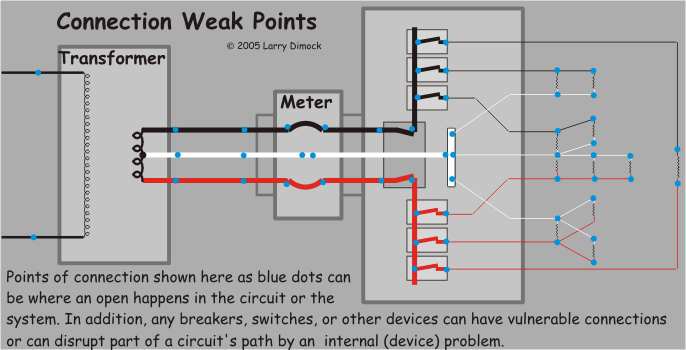
The Open. I estimate that the chance of an open happening in a given household during its lifetime is at least 50%. Since this is perhaps the most common electrical illness homes suffer, take heart! Hundreds of opens are solved around the country every day, and yours has no reason to be specially stubborn. Here is my electrical advice. Since an open is an unintended discontinuity, locating it can involve experimentally disturbing connections till the bad one makes good contact again briefly, or else figuring out fruitful places to look for the discontinuity.
First, you need to learn all you can about the extent of the outage and its circuit, so that you will be ready to probe into enough places and won't have to probe into any uselessly. Do not skimp on this step. Be thorough. You will be comparing the lay of the outage to the lay of the whole circuit.
So your first job is to know the outage. How well would you get to know it if I had to pay you $100 for every dead item you found, but you had to pay me $500 for every one you missed? You are very aware of the lights and outlets you no longer have the services of. What about the ones you never use and the ones behind furniture and stored boxes that you don't even remember exist? Are you going to overlook items that are unique or out of the way: the doorbell's transformer, a wired-in smoke alarm, or junction boxes in the attic or crawl space? Yes, you may have to get more intimate with your home than you were in the past. Document what your new intimacy reveals.
Your next job is to know the outage's whole circuit, if possible. For this you will need this same thoroughness and perseverance you exercised for knowing the outage. Yes, it is most likely that several more things of the circuit in question are still working. Don't rush to see what the labels on your panel say. They won't say enough and might even be lying. You can't afford to base your whole investigation on shaky assumptions. I don't care if you labeled it yourself, back when everything was working. You may have to do a little guessing later on, not yet.
And how can you tell which circuit the outage is part of? If it is the hot wire that is open -- not getting through from the bad connection onward -- you may not be able to learn its circuit. Yes, you could try to believe the panel, or you could turn off other circuits one at a time and see which one "seems less full" than the others. But you have a 50/50 chance that it is the neutral (white) that is open instead. If it is, you can absolutely know which circuit you are dealing with. You can -- if you get a tester. A neon tester, non-contact voltage checker, or (for circuits wired since 1970) a receptacle tester, will let you do this. They cost from $2-$20. How will they tell you whether the neutral is open? By lighting up or beeping when inserted in a non-working outlet or one of its slots. You know the neutral is bad from two facts: that the outlet can't run normal things and that it has a good hot, because the tester lit up. If the hot is good, then all you need to do to identify its circuit is turn breakers off one at a time while continuing to look for the light or beep of your tester.
If you were lucky enough to have an open neutral, don't slack off. Keep your luck going by doing as much research on the full extent of the working items as you did on the non-working ones. Notice, I don't call them dead, because in your case they have a live (hot) wire at them, which is quite able to shock you when you have the circuit on. Again record everything on the circuit that works, including those out-of-the-way items.
Good. And you folks with the open hot, don't despair. You will have your day. And you tester-less people, don't count yourselves out. Now, whether your open is of the neutral or the hot or unknown, you are going to try to disturb the bad connection back into working briefly. I call this The Jiggle Method. If you know the circuit's working things from its non-working ones, or can only guess that nearby working things may be part of the same circuit as your non-working things, you can now get down to the real work. Have all circuits turned on. Go plug a working, turned on lamp or nightlight (radio?) -- something that will work instantly without a lag -- into one of the non-working outlets. (If the outage involves no outlets, turn on the non-3-way switch of a non-fluorescent light within the outage area.) Then assign someone else the job of watching that light constantly and reporting to you immediately if it tries to light up -- even the slightest flash. I suppose you could drag a light on an extension cord around with you, all by yourself.
Ready? Position yourself among all the non-working items you discovered. Face toward your electrical panel. As you move in your imagination, without regard to walls and floors, toward the panel, the first working items (of the circuit, if you know it) that you would start to pass into the midst of are crime suspects, along with those non-working items nearest to these working ones. You, the detective, are to go take the covers off all outlets and switches -- dead or alive -- along this Dead/live border.
Now use The Jiggle Method. Plug something else into these outlets, one after another, and wiggle it side to side somewhat. Next go back to the same outlets, and also to the switches, and stick a strong, thin stick of plastic or wood, not metal (e.g., a chopstick) beside the device, pressing firmly on the wires you see, and then stick it more behind the device, pressing and poking various wires you can't entirely see. You can even pound on the wall or ceiling near the boxes of this electrical border. The purpose of all these activities is to disrupt wires back into good contact. If at any time your helper tells you the light flashed or stayed on, stop where you are! This is where the connection needs to be improved!
This Jiggle Method will often succeed, but certainly not always. This is the point at which you sad people with the open hot get a shot of hope, and the open neutral folks have to sit down and rest awhile. The reason is, if you invested in one of those non-contact voltage checkers, you can now try letting it tell you where the open hot is. You see, a 50/50 chance has come around to you now. There is a 50% chance that the open is at the first non-working box along the circuit. The other 50% is that it is at the last working one. Therefore, if you were to stick that volt-stick past all non-working receptacles or switches to the wires behind them, you have that 50% chance that it will register steady hotness, telling you that you have found the bad spot! Be sure it gets up against each of the wires in the box. You will probably have to loosen the device from the box, somewhat, to do this. If no non-working device shows this hot wire behind it, then it will probably be one of the exposed working devices that hides the problem. You will need to visually and manually check or improve the black-wire connections at these places, with the circuit turned off.
You open neutral people, however, will have to resign yourselves to checking and improving the white-wire connections at both the non-working and the working places on this dead/live border (shown opposite). Those who cannot be sure what things are part of the outage's circuit will have to check and improve connections of both colors in the general area of the outage and of nearby working things, with circuits off.
When I say that 50% of the time the open will be found at the first non-working item and 50% at the last working item, I exaggerate only a little. The exceptions are: junction boxes (which can't be said to "work"), rare inaccessible splices or breaks, the chewing of rodents (also rarer than imagined), and underground splices. Nevertheless, generally, the trouble point will be found in electrical boxes, including the panel.
More possibilities. It was common in homes built 1940-1970 to run a circuit through light boxes more than outlet and switch boxes, so there may be connections to be disturbed and checked there. Homes built 1900-1950 may still be relying on their original knob-and-tube wiring connections. If these were not soldered well, they can be the cause of an open. They are not found in electrical boxes but in ceiling and wall spaces. If they are accessible, someone jostling them with a stick could make the light, in The Jiggle Method above, flash on.
A restatement of how to find an open is found in the Diagnostic tree. If you have tried these things without success, a good professional may be needed. That includes calling me.
Things called testers are hardly the only way to learn the status of things in your electrical system. When they will be helpful, use them according to the manufacturer's instructions, common sense, and safety. Which testers make general sense for some purposes will be explored here. With this as background, you will be more ready to consider how best to test for particular purposes. The following chart lists some of the most common, available, and simple testers:
TESTER (for pictures see Site): |
GOOD FOR | LIMITATIONS | HOW TO USE |
|---|---|---|---|
| Electrostatic wand =volt stick =noncontact voltage tester | Indicates presence of hot without direct contact | Not reliable close to earth, can't distinguish within bundle of wires, sensitive to a range of volts and to inconsequential induced voltage | Hold wand near wire or cable at different angles till light or indicator stays on |
| Neon tester | Hot presence pinpointed, relative brightness for different voltages | Good reading doesn't mean load will run | Touch one prong to hot, the other to yourself or something grounded |
| Three-prong receptacle tester | Quick, usually reliable for hot presence and (if there is a ground) neutral presence; some can also test GFIs | Depends on ground or neutral presence to work, descriptions can mislead, good reading doesn't always mean load will run, does not tell positively that hotness is absent | Plug into three-hole receptacle, read about resulting lights from list |
| Voltmeter | Volt presence and level | Good reading doesn't mean load will run | Touch one prong to each thing to tell voltage difference between them |
| Ohmmeter | Continuity and resistance level | Does not tell what resistance is under load (e.g., light bulbs, motors) | With circuit off, touch one prong to each thing for resistance between them |
| Clamping ampmeter | Checks overloads and shorts in progress, whether something is running | -- | Clamp around single wire, not whole cable |
| Electromagnetic circuit finder =current tracer | Can pinpoint which breaker controls a live circuit. | Occasionally inaccurate; only expensive ones can trace wires in walls and underground | Transmitter plugs into receptacle; receiver indicates breaker at panel |
| "Wiggins" =solenoid voltage tester | Some ac and dc voltage levels, checks circuit operation under load, presence of good ground, can roughly test GFI | Does not tell positively whether hotness is present | Touch one prong to each thing to tell voltage difference between them |
| Light bulb in socket with two wire leads | Checks 120-volt circuit operation under load, presence of good ground, can roughly test GFI | Does not tell positively whether hotness is present | Touch one wire to hot, one to neutral or ground |
| Mechanic's Stethoscope | Hears arcing location | -- | Touch to nearby non-metal or grounded part; listen |
| Continuity tester | Tells general continuity | Cannot distinguish between a short and many normal connected loads | With circuit off, touch one prong to each thing for continuity (or not) between them |
| Multimeter | Combines voltmeter and ohmmeter | -- | see ohmmeter and voltmeter |
A tester is like a question. If you don't ask the right question, the answer may be puzzling. The brief comments in the chart above are to guide you, generally, in picking the right tester for the right question. Sometimes more than one tester will need to be used, and sometimes only in a certain order. So my further comments here will elaborate what the chart says and alert you to issues you may not be aware of. I am writing in general about what sort of tests are needed for different situations. For specific suggestions on good ways to test for different things you are welcome to consult How to Test for What. But I think it will help if you first understand the logic behind those suggestions.
Anytime you are about to use a tester -- I could say "are tempted to use a tester" -- ask yourself what your purpose is. Suppose that you answer that you want to know, "Is this thing hot?" Even within this question there are different possible purposes. You may just want to know if you are personally safe handling a wire, screw, etc. Or you might want to know as part of troubleshooting a problem, whether you are dealing with a healthy hot wire that is capable of doing its job in the circuit. Or instead, you might have a reason to be interested in how hot it is, interested in measuring its degree of hotness -- its voltage. But these different purposes call for different testers. There is no generic "hotness tester." This is because the concept of hotness is not clear until a person clarifies their intent.
So, for instance, a non-contact tester or a neon tester can tell you when it is probably safe and when it is probably not safe to touch a wire. Other testing can make these probabilities certain. But these two testers cannot determine for you whether a wire they say is hot can carry more than a tiny bit of current, because they don't use much (neon) or any (non-contact) current themselves. Sometimes a poor connection upstream from a wire that registers as hot this way, won't let enough current through to run anything important.
Other testers that don't draw much current are the 3-prong receptacle tester and the voltmeter. So they can't tell us that a circuit is good in every respect, but they will tell us if a circuit is bad in some respects.
On the other hand, a solenoid-type tester or an ordinary turned-on lamp will tell whether the circuit, at that point, is capable of running a load. But when they don't light up or vibrate, this is not, by itself, any indication that everything there is dead and safe.
Of the six testers mentioned so far, only the first two can indicate some hotness independent of the presence of a good ground or good neutral. The non-contact and neon testers can do this by using your body as a slight source of ground. When the other four testers fail to show voltage between wires, they do not automatically let you know which is bad, the hot or the neutral/ground. The 3-prong tester attempts to overcome this difficulty by simultaneously checking voltage from the hot to each of the other outlet holes -- neutral and ground. This does enlighten you if at least one or the other of those holes is indeed grounded. But if neither is grounded, the tester is suggesting that the hot hole isn't hot -- "open hot" -- which may not be true at all. For more, see 3-prong testers.
The last two I want to comment on are the ohmmeter and the continuity tester. They both try to send battery current through a path by connecting to two points believed to be two ends of such a path. Unlike the testers above, then, these two are primarily power sources. They let you know if their power has succeeded in finding a complete path, by using that power to move a needle or light an indicator bulb. I do not find the continuity tester as helpful as an ohmmeter because the continuity tester will light up -- or buzz, if it is that type -- for paths that have a certain level of resistance but not for resistances that are a bit higher. Even the times I use an ohmmeter are usually limited to checking if an ordinary light bulb or fuse is bad.
If I am checking a switch, I usually have a 120-volt hot available and simply see if it gets through the switch when On and not when Off. If I want to see if a wire at one outlet goes to another outlet, I tend to use a 120-volt source. Continuity and ohm testers might be used for the same purposes with the circuit off, but I see them as notoriously confusing unless the person knows exactly what the results will mean in each situation. Performing tests just out of curiosity is generally distracting. To understand the readings you get might mean mapping out an entire circuit and understanding the resistances of many things on that circuit. I think you'd rather concentrate on solving your problem.
There is usually no reason to repair or replace anything with the circuit still live, and a good reason not to -- your safety. Also, some timers, dimmers and photocells have fragile components that can be damaged if connected to a load while live.
Repair will involve separating a wire from something, improving a wire's connection, and/or replacing a device or connector. If damage has visibly occurred to a wire it can usually be cut back or sometimes taped up, to restore insulation. If a device has (also) suffered from heat, corrosion, or arcing, replacement is usually called for.
To remove wires from pushed-in-the-hole terminals of receptacles and switches, depress the release near the hole using a very small screwdriver, and pull on the wire. If this does not work, try rotating the device back and forth while pulling back on the wires. Beyond this, just cut the wires loose, close to the device.
Check these sites on Replacing a breaker, some Repairs and replacements, and things to consider when Changing wiring.
Here are some specific tips:Searchers who need to read the material on this page may be using terms found in this statement: My electrical advice to trouble shoot a home electric short that pops the circuit is, first see if the popping circuit breaker is bad, weak or burned out; or is a GFI circuit.
Short-circuit article by Wikipedia